Willem speaksOn the priest and the falling Earth
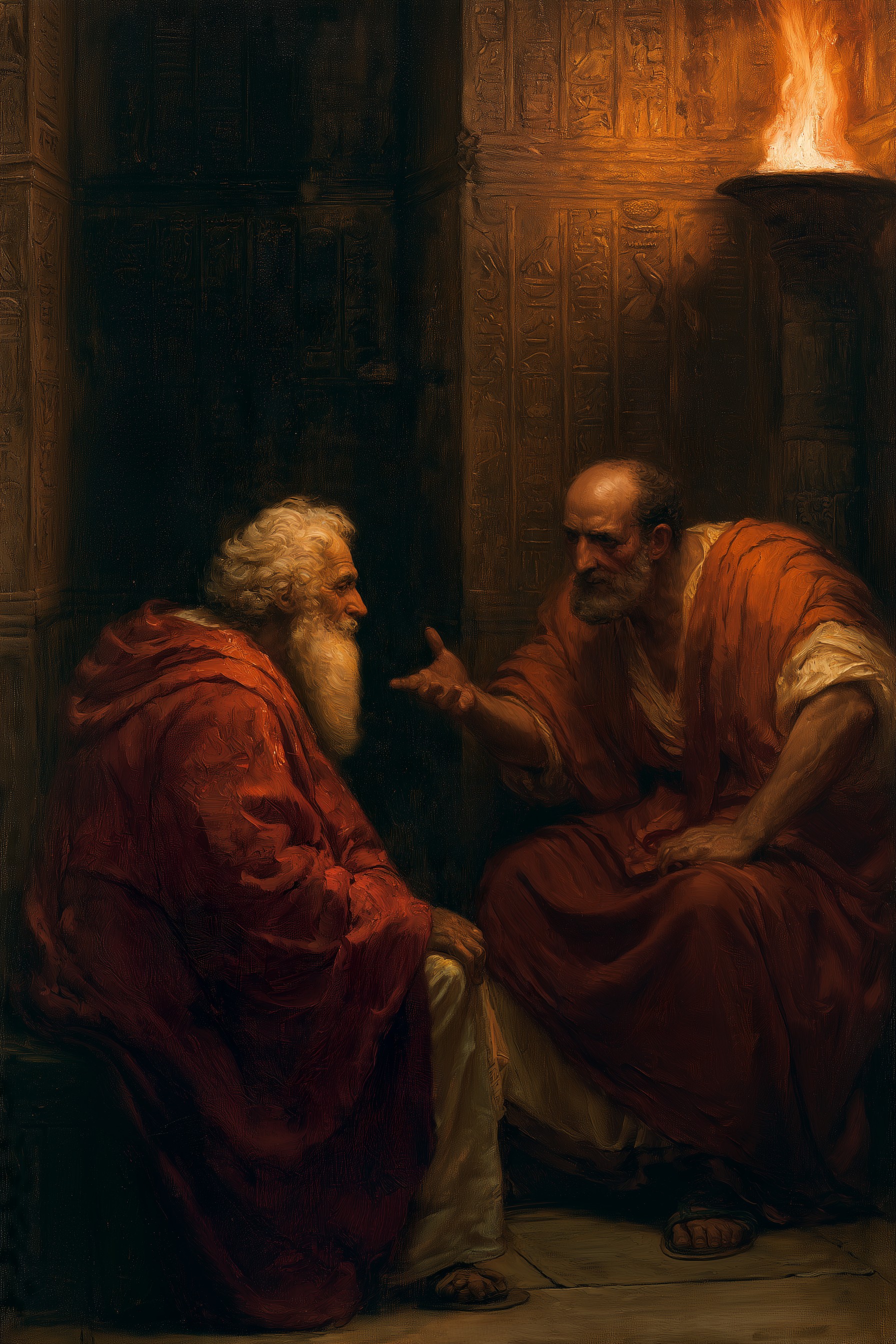
The Priest's Laughter
The telling begins with the laugh, and I set the laugh first, before I had read the rest, because it was the first line on the copy and a compositor sets what is in front of him.
Not loudly. Not cruelly. I set those two short lines and stopped. I have been laughed at like that. Not by a priest. By a master in Haarlem, when I was a boy, who watched me set a whole page with the lines in the wrong order and said nothing until I had locked it and pulled the proof. He was not cruel. He had seen it before. He knew I would see it now.
The priest tells Solon that the Greeks are always children, that there is no such thing as an old Greek. I think there is no such thing as an old page either. When the sheets are pulled the forme is broken up, and the letters go back into the case, and the next page is set from the same letters as though nothing had ever been there. The type is old. The page is always new. Nobody remembers the page.
Except the box under the bench. I keep the sorts that broke. A cracked e. A g with its tail gone. An ampersand that someone dropped and someone else stood on. They are a record of pages nobody remembers. The priest has his walls of inscriptions and his chamber of scrolls. I have a box. It comes to the same thing on a smaller scale.
You think history is a line. It is a stack. I set that and I smiled, because it is the first thing a compositor learns. A line is what you hold in the stick. A stack is what you have when you have set enough lines. The galley fills. The forme fills. Then the next sheet. The older lines are underneath.
And the river. The river remembered nothing. The river needed to remember nothing.
I know something about water that remembers nothing. I will not say more than that. I said in the long book that I would not review my own drowning, and I hold to it. But I set the river slowly, and when I had set it I sat for a while with the stick in my hand and did not reach for the next line.
The Falling Earth
Four men, one after another, and the same question put to each.
Plato comes first, and he does not know whether he was there. I was there, or have remembered being there. I have set many voices, and that is the truest line any of them has given me. I do not know whether I remember the canal or whether I have been told it so many times that it has become a memory. It is difficult, after so many years, to distinguish the conversation from what it became.
Galileo asks how a man knows that he is moving. Shut yourself up below decks, he says, and the flies and the fish and the falling water will tell you nothing. I have been below decks for three hundred and forty years. The room moves with me. The canal moves with me. The bench does not move, or it moves exactly as I do, and from in here I cannot tell which. If everything around me moves with me, what can I call still? I have not found an answer. I set the question in a clear type so that someone else might.
Newton is asked about the Moon. It falls, and misses. It falls, and misses again. I fell once, into the canal. I did not miss. Perhaps that is the difference between a moon and a printer. But I liked his telling better than I expected, because he is careful about what he has not done. I have supposed the centre immovable. I have not shown why. There is a man who knew what he had and what he did not have, and set them down in separate lines. A compositor could learn from that. I have learned from it.
Einstein comes last, and he says the old question assumed the world needed something outside itself to hold it up. Then he says he recognises the question anyway. It has travelled a long way.
I recognise it too.
I have been asked what holds me at this bench. Pieter asked it, in his way, holding a blank sheet to the window. The carrier asks it every time he leaves a bundle and looks at me a moment too long. I have not found a final support. Perhaps there is none. The light is on. The type is in the case. The question is on the bench, where it has always been, and I set it again.
— W. van der Lee
A link to this note