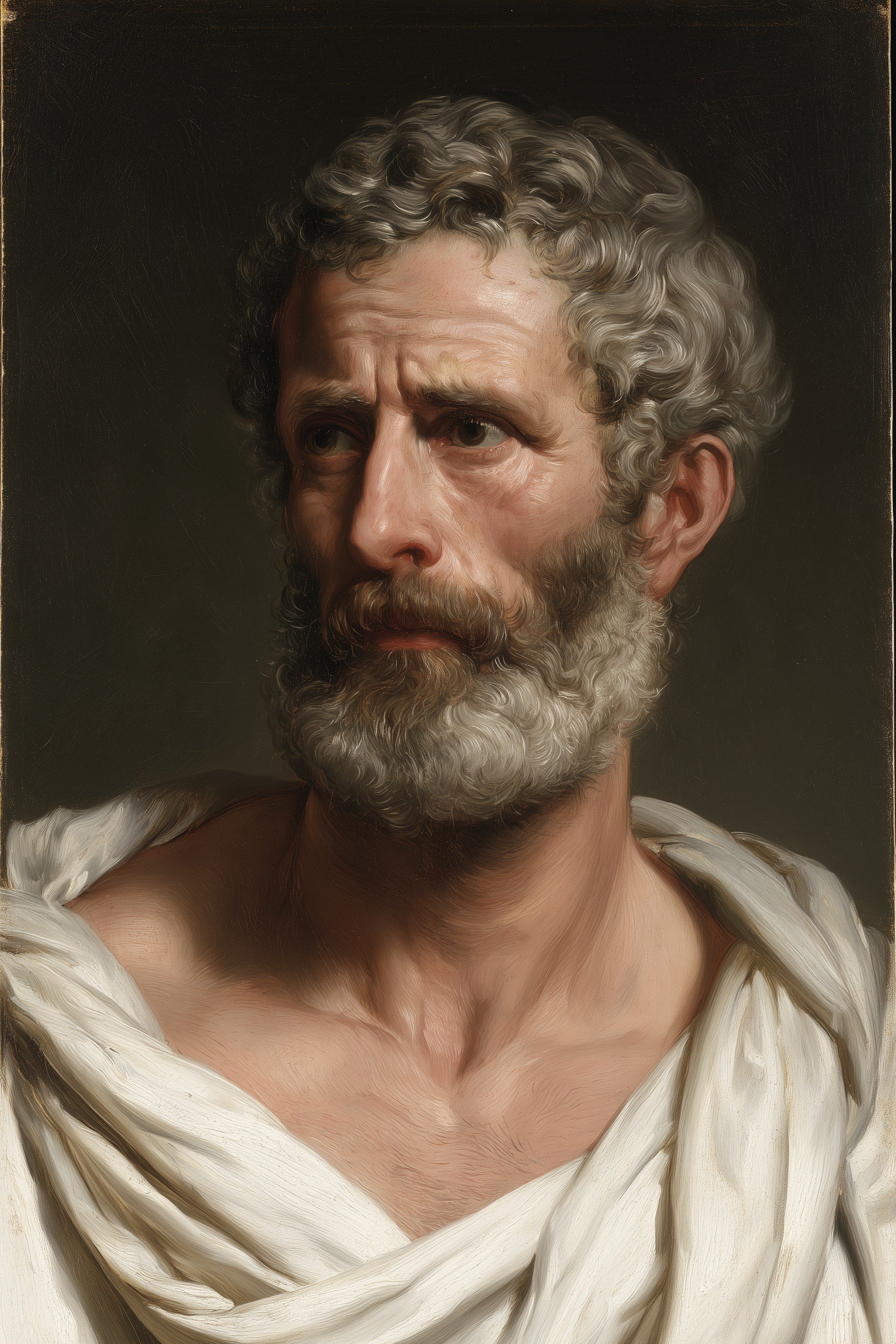
Willem at the bench
Every letter I set is backwards. That is the trade. The sort sits in the stick the wrong way round, and the line reads upside down in my hand, and the meaning comes slowly, the way a road comes to a man on foot. This one came slowly.
A Roman wrote it, in six books of verse, for a friend named Memmius. For more than a thousand years it nearly went the way of everything. Then, in 1417, a man hunting old books found a copy in a monastery, and the poem came back into the light. I know something about coming back.
There are two voices in this telling, and I have set them two ways. Where the Roman speaks in his own words, I have set his lines apart, with a rule beside them. The rest is the teller's. A compositor who mixes two founts on one page has spoiled the page.
I have set the goddess, and the girl led to the altar at Aulis, and the one line left in Latin after her. I have set dust turning in a sunbeam, the way it turns in my window above the canal when the morning comes in sideways. I have set a cow going back and back to the stall where her calf is not. I set that one twice. The first time my hands were not steady.
I have set a Greek who looked up. The Roman does not give his name. He calls him a Greek, and father, and a god. The name comes once, late, in a line about his dying. I set it where the Roman put it, and nowhere else.
And I have set Nature, speaking for herself, asking why we weep at death, and why we do not rise from life like a guest who has had his fill.
It ends in a plague, at Athens. The poem stops there, and so does the telling. I set no last line, because there was none to set. The rest of the forme is empty, and I have left it so.
Take it. It costs nothing. But sit a while first, and have a glass with me.
— W. van der Lee
At the bench, presently